Over the last 11 years at SNS, we’ve worked with around 100,000 British teenagers, and nothing gives me more hope about the future of British society and the world in general, than these interactions. Despite stereotypes and assumptions that teenagers today are social media obsessed and don’t read books or think critically, I’ve experienced things that tell me a very different story. Let me explain.
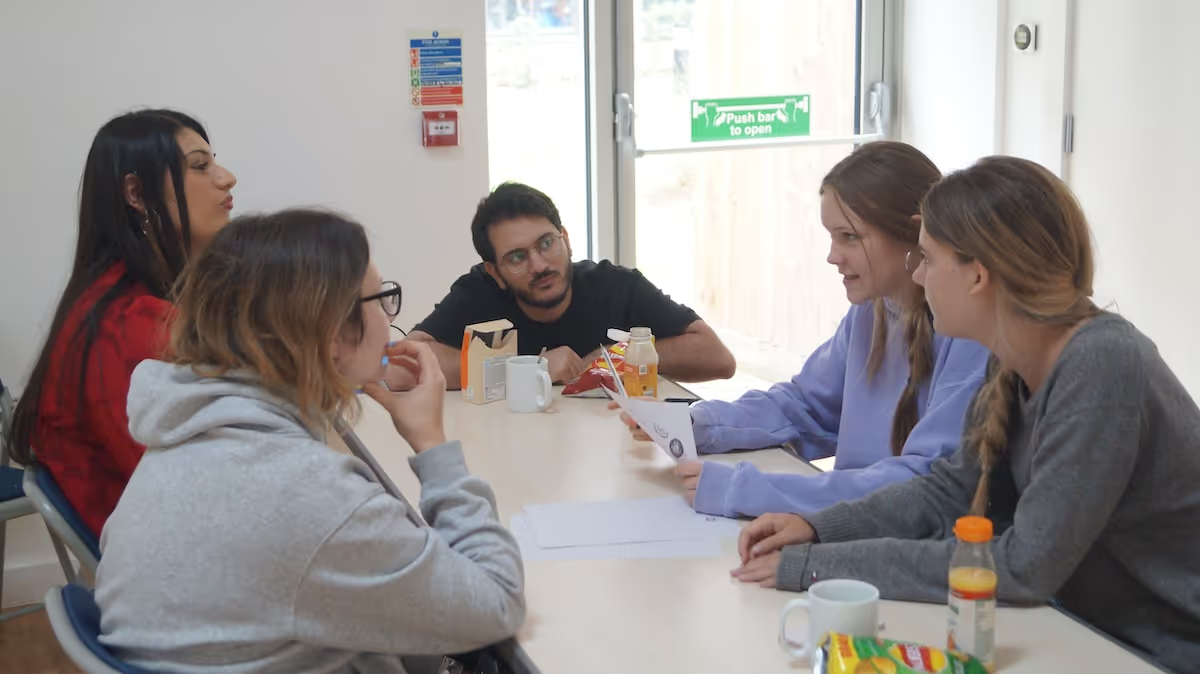
SNS goes into British classrooms and holds SNS Spaces for teenagers at our Youth Leadership Programmes on the thorniest issue from the last few years; Palestine-Israel. This is an issue that has contributed to divisions and polarisations in society including rising antisemitism and Islamophobia, and which countless well known people in the world including politicians, musicians, actors, and influencers have taken strong and often simplistic positions and encouraged their followers to do the same. You’d think, therefore, that young people would be unable to grapple with diverging narratives or hold multiple truths and perspectives in one room at the same time. If adults can’t do it, how would it be possible for teenagers to do it? And yet within the conditions described below that SNS creates for them, they more than just do it—they excel at it.
Curiosity: An SNS space vibrates with curiosity; you may enter with a strong view and preconceived notions and ideas about the others in the room or the ideas that will be discussed and that’s okay—in fact, that’s welcomed. However, the real strength and confidence in ourselves comes from openness, acceptance, and curiosity to others. Teenagers I work with aren’t afraid to express their views and their perspectives, but they also see the people in the room from Israel and Palestine as humans, role models, and sources of new information, and they aren’t afraid to ask questions that are both personal and political about the micro and the macro. “How can you stand next to someone who is seen as an enemy?”. “What was it actually like crossing checkpoints every day?”. “What’s your definition of terrorism?”.
Language: When it comes to discussing Palestine-Israel, there are a myriad of words, terms, and definitions which have different meanings to different people. Understanding there is a difference between intent, reception, and impact, and how to be considerate when bringing terminology in, is key to an SNS space. We do not judge, shame, or tell off anyone for using language that is right or familiar to them. Instead, we connect with curiosity and help people to understand how language is powerful and can open up or shut down a conversation. Most teenagers haven’t had any opportunity to have a conversation with a trusted adult who will allow them to speak in the way that is right for them whilst also helping them to understand how language lands differently for different people. We give them the chance to ask and to feel seen and empowered. Most teenagers want to feel this way rather than feel silenced by adults or their peers, or to feel like they’re going to get shouted at or shamed for making a mistake. “What is Zionism?” “Why do some people get upset by the saying: ‘From the River to the Sea?’”
Empathy: Philosopher Emmanuel Levinas opined how face-to-face encounters bring about ethical responsibility because once we encounter someone in person and engage with their physical humanity, we feel more of a connection to them. Inspired by this, an SNS space revolves around physical presence in the room, and an ability for everyone to see the speakers and each other, face-to-face, without using phones, screens, or tablets to interfere with this basic form of human interaction. Whilst technology allows us to virtually peer into other spaces, research and our own experiences tell us that nothing can replace the face-to-face. I have been amazed, particularly since covid and the loss of face-to-face interactions for hundreds of thousands of British youth, how well teenagers can sit and actively listen. How they look into your eyes and the eyes of the speakers and show acknowledgement, empathy, and understanding, without even saying a word. On a weekly basis, I also see teenagers confidently coming to speak to us after the sessions, to delve deeper into the topics, to politely and confidently engage in ideas, and to express appreciation for the strangers who walked into their space only two hours ago. If this is how they interact with us and with this issue, I can’t wait to see how these teenagers go out into the world and treat others.
Mental Health: Young people are much more attuned to mental health and its challenges. I see how much this informs their perceptions of others and their ability to see others as human beings, with needs, with challenges, with pressures, with their own individual world, rather than a simple walking identity, ideology, or idea. I have seen how teenagers will listen to the stories of the Palestinian and Israeli speakers, even if they have strong disagreements with governments, nations, or ideologies that they may associate to them, and show profound care about the individual, their families, and their communities. In most sessions I have run over the last 2.5 years in particular, students ask: “How do you take care of your mental health?”, “how does living under occupation/under blockade/under attack/at war affect your mental health?”, “are you doing okay today?”. The understanding and care shown outshines that of many adults today, particularly those who simply engage online.
Action: British teenagers care about the world, about each other, and many care deeply about Israel-Palestine. They want to do something to contribute to making change but they often don’t know how. They don’t want to upset anyone, be called racist or a terrorist, and they feel the weight of judgement and a world of poor role models weighing in on them. And yet, in every single session we do, they ask:”‘How can we help?” “hat can we do?”, “what will create long lasting change?”. Every year our Bridge Builders summer programme is oversubscribed, our day leadership programmes are full, and every student who enters our classroom gets activated by our conflict resolution exercises. The Palestinian and Israeli speakers model agency, decision-making, and how to take action within the power spaces you have, even in the most trying and stressful of contexts, and this inspires our young people to do the same.
We owe it to young people to uplift them, trust in them, empower them, and carry them with us as we all navigate the challenges of 2026 and beyond. This starts with us adults taking them seriously, including them in democratic processes, and giving them opportunities for growth and dialogue. If they can do it, so can we.